
College of Humanities and Law Holds Special Seminar on Graduate Admissions and Training
To further implement the fundamental task of fostering virtue through education and to advance reforms in graduate admissions mechanisms and training systems, the College of Humanities and Law held a special seminar on graduate admissions and training on the morning of January 9 in Conference Room 120 of the Teaching Building on the East Campus.
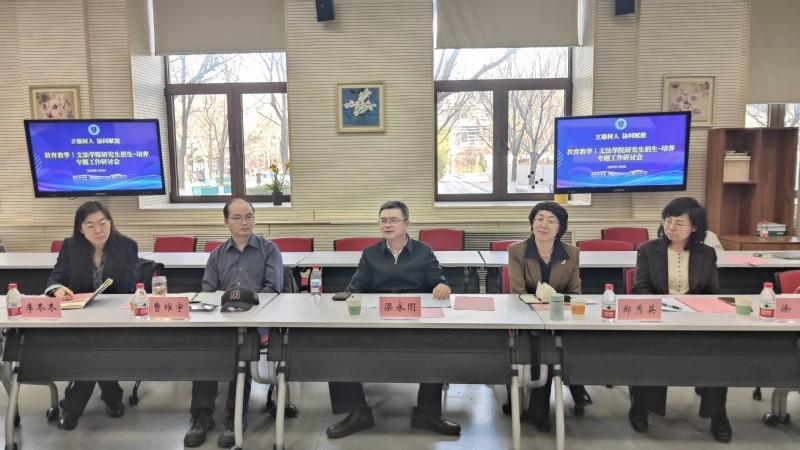
The seminar was chaired by Zheng Xiuying, Secretary of the Party Committee of the college. Liang Yongtu, Member of the University Party Standing Committee, Vice President of Beijing University of Chemical Technology, and Dean of the College of Humanities and Law, attended the meeting and delivered remarks. Li Dongdong and Cao Weiyu, both Deputy Deans of the Graduate School of BUCT, were invited to participate and speak. Also attending were Xu Jun, Vice Dean of the College, heads of degree programs, and more than ten faculty representatives.
At the seminar, heads of degree programs delivered reports based on the actual conditions of program development, focusing on the current status of graduate admissions and training, existing problems and their underlying causes, benchmarking against peer institutions, and proposed measures for quality improvement. Other participating faculty members, drawing on their respective responsibilities as well as their experience in admissions and teaching, offered comments and suggestions.
During the discussion session, Li Dongdong introduced national policies related to graduate admissions and explained the basis for allocating newly added enrollment quotas. He responded to specific questions raised by degree programs and provided recommendations on expanding high-quality applicant pools and strengthening publicity and outreach efforts. Cao Weiyu presented an overview of disciplinary rankings in Law and Public Administration, analyzed weaknesses in current training systems, and proposed strengthening curriculum development and enhancing the level of internationalization in graduate education.
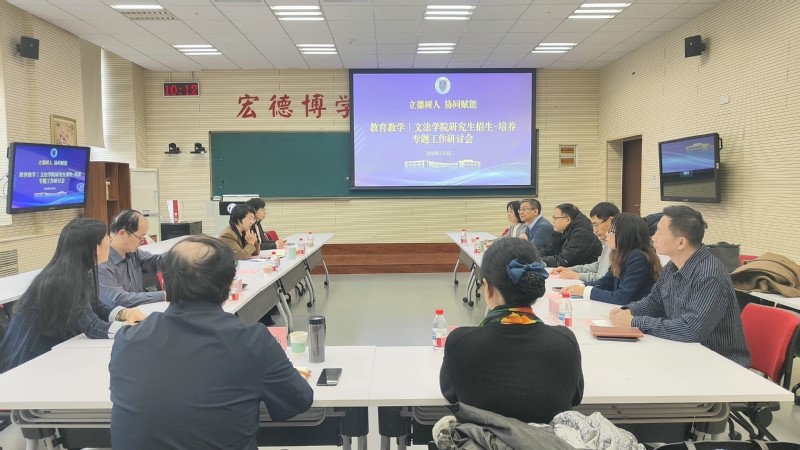
In his concluding remarks, Liang Yongtu emphasized two key principles: “upholding the bottom line” and “enhancing quality.” In the admissions process, he stressed strict adherence to national policies, optimization of selection criteria, and improvement in the quality of student intake. In graduate training, he called for strengthening academic norms, continuously innovating training models, and enhancing students’ practical and innovative capabilities. With regard to employment, he underscored the importance of reinforcing career guidance to promote high-quality graduate employment outcomes.
