
Faculty Development Workshop (Session IV) | Open Dialogue and Collaborative Partnership
On the afternoon of April 30, 2026, the fourth session of the Faculty Development Workshop, together with the 12th Public Governance Forum, was held at the Chaoyang Campus of Beijing University of Chemical Technology. Centered on the theme “Public Administration in the Digital Era: Frontier Research and International Collaboration,” the workshop featured a keynote lecture by Vishalache Balakrishnan, Director of the Centre for Research in International and Comparative Education (CRICE) at the University of Malaya, titled “The Role of Public Administration in International Service Learning in the Digital Era.”
The event was attended by Feng Jianghong, Deputy Director of the Office of International Exchange and Cooperation; Zhou Xueying, Head of the Department of Foreign Languages; and faculty representatives from the College of Humanities and Law. The workshop was moderated by Zhang Fan, Head of the Department of Public Administration.
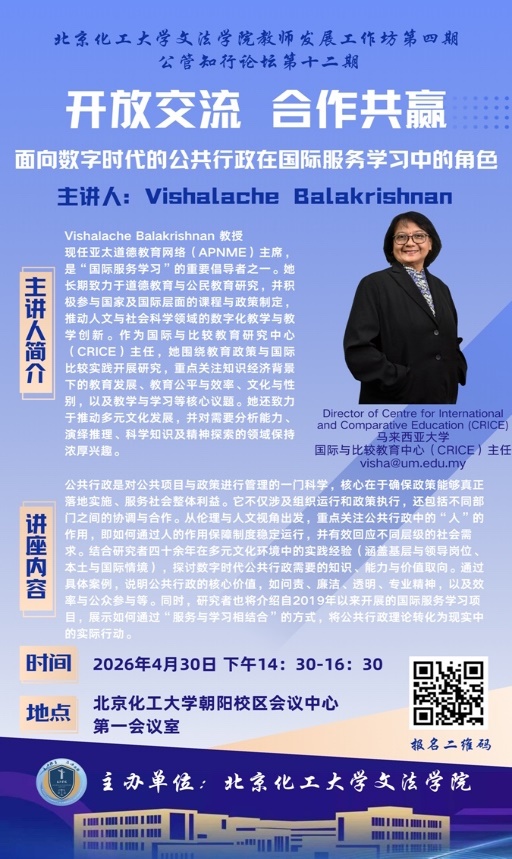
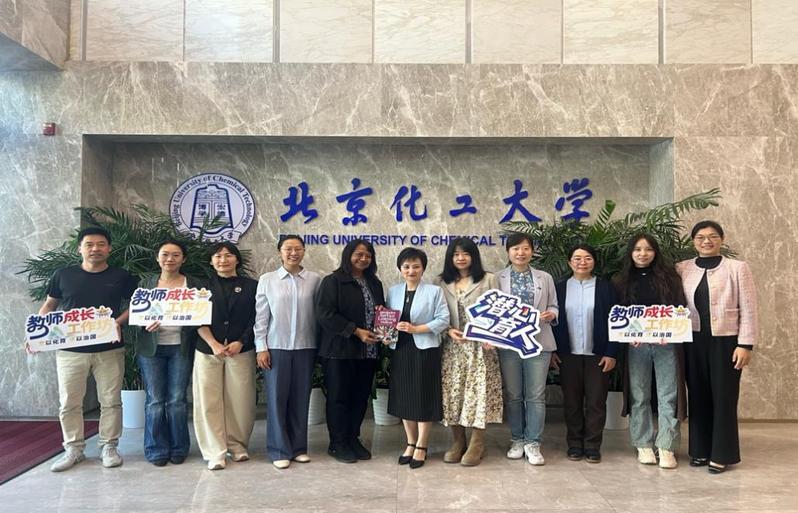
In her opening remarks, Feng Jianghong welcomed Professor Balakrishnan and emphasized that international exchange and cooperation are vital pathways for advancing disciplinary development, broadening faculty academic perspectives, and promoting the internationalization of talent cultivation. She expressed hope that the workshop would further strengthen collaboration between the College and leading overseas institutions in research, faculty and student exchanges, and program development.
In her keynote lecture, Professor Balakrishnan discussed the value foundations of public administration in the digital era, the essential characteristics of service learning, and directions for international cooperation. She noted that public administration is not only concerned with managing public programs and policies but also with enhancing social well-being, safeguarding public values, and fostering inclusive development. Drawing on service learning practices in Malaysia, she clarified the distinctions between service learning, community service, and volunteer work. She emphasized that service learning should be curriculum-based and guided by real community needs, integrating academic learning with social engagement to cultivate students’ sense of inquiry, responsibility, and public ethos.
Following the lecture, Gong Xiaochen from the Department of Public Administration introduced the department’s overall development in areas such as disciplinary planning, faculty team building, research priorities, and talent cultivation. Leveraging the science and engineering strengths of the University, the department focuses on research fields including digital governance, science and industrial policy, green governance, and social policy, with the aim of cultivating governance professionals equipped with international perspectives, analytical competence, and a strong sense of public ethos.
During the discussion session, participating faculty members engaged in in-depth exchanges with Professor Balakrishnan on topics including the design of international service learning courses, talent cultivation in public administration for the digital era, cross-cultural collaborative projects, and pathways for student international exchange. Faculty members actively shared insights from their disciplinary backgrounds and teaching practices. They explored how to integrate the principles of service learning into public administration courses, expand joint international teaching and research initiatives, and foster globally minded governance professionals with a strong public ethos.
The workshop offered both theoretical inspiration and practical value, providing meaningful insights into the mission, methods, and international cooperation pathways of public administration education in the digital era. It also marked an important initiative by the College to promote faculty development and academic exchange, as well as a valuable opportunity for the Department of Public Administration to expand international collaboration and deepen research on digital public governance and service learning.
Looking ahead, the College will continue to enhance its level of internationalization by actively exploring diverse modes of cooperation, including joint training programs, short-term exchanges, co-teaching initiatives, visiting scholar programs, and international collaborative research.
