
College Successfully Hosts Lecture on “Oportere” and “Responsibility”: Re-examining the Logic of the Law of Obligations in the Civil Code of China
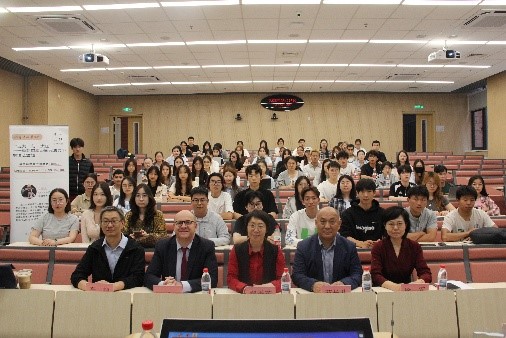
On May 15, 2026, the 8th session of the “Huayu Forum” was successfully held at the Changping Campus. The lecture, titled “‘Oportere’ and ‘Responsibility’: Re-examining the Logic of the Law of Obligations in the Civil Code of China,” featured Stefano Porcelli, Associate Professor at the University of Brescia and Adjunct Professor at the Institute of Comparative Law of China University of Political Science and Law, as the keynote speaker. The event was attended by Party Secretary Zheng Xiuying and Vice Dean Xu Jun, moderated by Vice Dean Xue Changli, with Associate Professor Li Chao from the Department of Law serving as discussant.
Professor Porcelli began by tracing the legislative evolution from the General Principles of Civil Law to the Civil Code of the People's Republic of China, highlighting the deliberate choice not to establish a formally defined “General Part of the Law of Obligations.” He raised a fundamental question about the underlying systematic logic behind this legislative design.
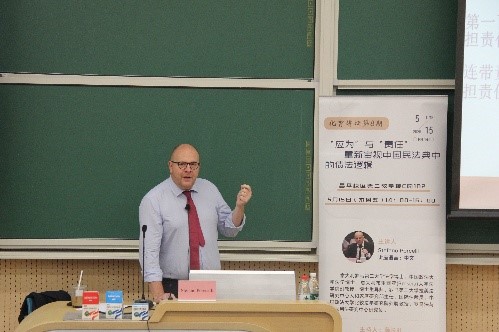
To illuminate the deeper theoretical implications, he drew on the distinction between oportere and damnatio in Roman law, outlining the historical progression from oportere (“ought to be done”) to obligatio (“obligation”) and eventually to responsabilità (“liability”). He argued that an obligation is essentially a cooperative legal relationship between equal parties, rather than a coercive liability relationship, and that the two belong to different legal levels.

Building on this framework, Professor Porcelli examined the development of the “General Part of the Law of Obligations” in modern civil codes worldwide and analyzed provisions such as Article 468 of China’s Civil Code. He demonstrated that a unified logic of obligations continues to substantively govern the operation of the Civil Code. Reaffirming this logic, he suggested, is essential for clarifying the hierarchical relationships among the dispersed institutional arrangements across different books of the Code.
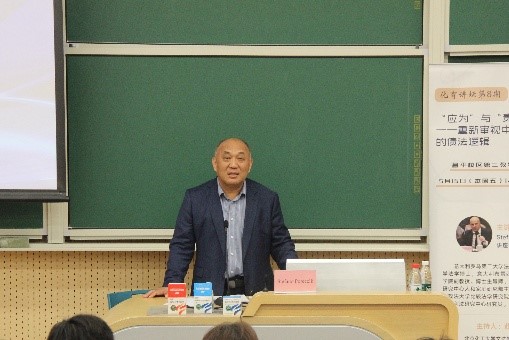
During the discussion session, Associate Professor Li Chao reviewed the key arguments of the lecture and offered responses and additions based on his own teaching and research experience. Students also actively engaged with Professor Porcelli, raising questions encountered in their studies.
In his concluding remarks, Vice Dean Xue Changli noted that the lecture integrated perspectives from civil law, comparative law, and legal history, and offered a historically and theoretically rich pathway for reinterpreting China’s Civil Code. He noted that the lecture went beyond simple institutional comparison and enabled a deeper cross-cultural dialogue. He encouraged students to solidly grasp the domestic rules of the Civil Code while expanding their comparative law horizons to better understand China’s civil legal system from multiple perspectives.
Following the lecture, Party Secretary Zheng Xiuying, Vice Dean Xue Changli, and Vice Dean Xu Jun held in-depth discussions with Professor Porcelli on topics including the joint cultivation of internationally oriented legal professionals, academic exchange, and inter-university cooperation.
This lecture deepened faculty and students’ understanding of China’s law of obligations system and further served as a bridge for the College’s international academic exchange. The College will continue to build on its disciplinary strengths by organizing more high-quality and diverse academic activities, inviting renowned scholars from China and abroad to broaden academic horizons and support the development of legal education and research.
